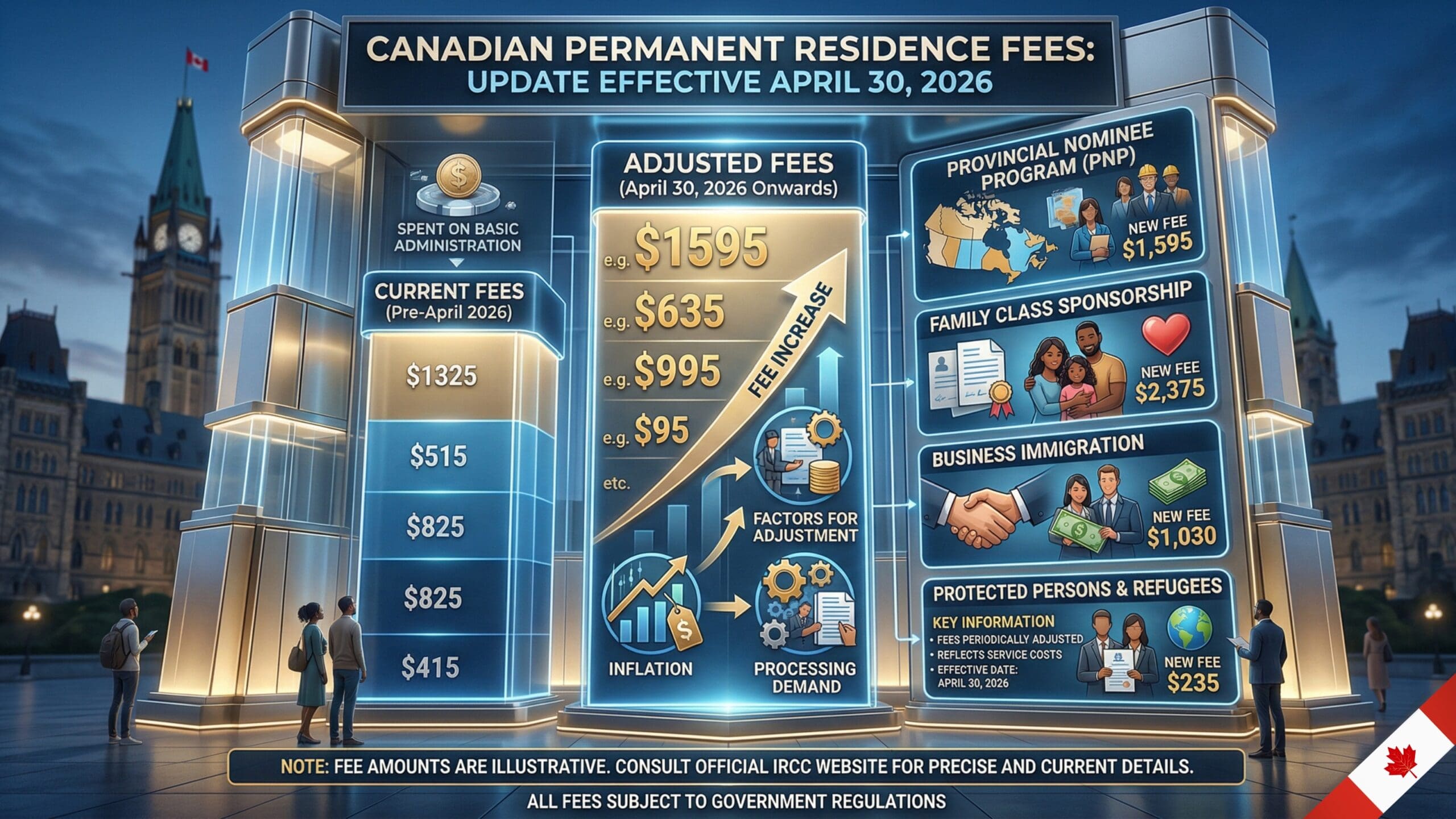
Permanent residence fees increasing on April 30, 2026
Ottawa, March 27, 2026 To continue delivering timely, reliable services and keep pace with inflation, permanent residence fees will increase on April 30, 2026.
Updated fees for principal applicants by program are:
- Right of permanent residence fee – increase by $25 from $575 to $600
- Provincial Nominee Program – increase by $40 from $950 to $990
- Business – increase by $85 from $1,810 to $1,895
- Family class – increase by $25 from $545 to $570
- Protected persons – increase by $25 from $635 to $660
- Humanitarian and compassionate grounds or public policy measures – increase by $25 from $635 to $660
- Permit holders – increase by $15 from $375 to $390
Under the Immigration and Refugee Protection Regulations, permanent residence fees are adjusted every two years to offset the cost of running the program and respond to growing demand.
Related Topics
More Latest News
May 15, 2026
What To Do If IRCC Refused Your Application by Mistake in 2026
Getting a refusal from IRCC can be frustrating, especially when you believe your application was correctly prepared. In some cases, refusals happen due to officer oversight, misinterpretation of documents, or incorrect application of rules. The good news is that Canada provides structured ways to challenge such decisions. This article explains the practical steps you can take after an IRCC refusal error in 2026. STEP BY STEP ACTION PLAN AFTER AN IRCC REFUSAL If your application was refused and you believe a mistake was made, follow these steps in order to respond effectively. 🔹 First Understand the Exact Reason for Refusal Before doing anything else, it is important to clearly understand why IRCC refused your application. The refusal letter alone usually does not provide full details. Why this matters What you should do 🔹 Request Internal File Details (GCMS Notes) GCMS notes contain the complete internal record of your immigration application. They are essential for identifying whether an error actually occurred. What GCMS notes include How to get them Expected timeline What to focus on 🔹 Submit a Reconsideration Request (Request for Re-Review) If GCMS notes show a clear mistake, you can ask IRCC to review the decision again. When this works best When it is less effective How to write it properly Important note This request is free and reviewed by a different officer, but approval is not guaranteed. 🔹 Contact Your Member of Parliament (MP) If your case is delayed or urgent, you can request help from your local Member of Parliament. When this helps Key point MPs cannot change decisions, but they can help speed up communication with IRCC. 🔹 Explore Federal Court Review (Judicial Review) If earlier steps fail, applicants may challenge the decision in Federal Court. When this option is used Important deadlines Process overview Key limitation The court does not directly approve your visa; it only reviews fairness and legality of the decision. 🔹 Choosing the Right Response Strategy Your next step depends on your situation: If a document was wrongly marked missing If eligibility was misapplied If reconsideration fails If unclear about the refusal 🔹 Common Mistakes Applicants Should Avoid Reapplying too quickly Waiting too long Skipping GCMS notes 🔹 FINAL SUMMARY When IRCC refuses an application due to a possible mistake, applicants have structured options to respond. The most important first step is understanding the real reason using GCMS notes. After that, a reconsideration request is often the strongest initial response, followed by escalation through an MP or Federal Court if needed. Taking timely and correct action is crucial, as delays can affect immigration status and legal options.
May 8, 2026
Ontario is preparing a major redesign of the Ontario Immigrant Nominee Program (OINP) in 2026
Ontario is preparing a major redesign of the Ontario Immigrant Nominee Program (OINP) in 2026. This is not a minor policy update but a structural shift that redefines how immigration selection works in the province. The system is moving away from broad, education-based immigration and toward a more focused model centered on employers, regulated healthcare roles, and high-impact global talent. Ontario OINP 2026 Changes Explained Ontario is restructuring almost all existing immigration streams in two phases. In Phase 1 (Spring 2026), the three Employer Job Offer streams, Foreign Worker, International Student, and In-Demand Skills, will be merged into a single system called the Employer Job Offer Stream (TEER 0–5 coverage overall, split internally into two tracks). In Phase 2 (Late 2026), Ontario is expected to eliminate or significantly restructure the Master’s Graduate Stream, PhD Graduate Stream, and potentially the Human Capital Priorities Stream. These will be replaced by more targeted pathways focusing on labor demand and specialized talent. At the same time, Ontario will introduce three new streams: the Priority Healthcare Stream, the Exceptional Talent Stream, and a redesigned Entrepreneur Stream focused on active business ownership, especially in rural regions. New Employer Job Offer System Structure The new system is centered around the Employer Job Offer Stream, which is now the core immigration pathway under OINP. It is divided into two internal tracks based on occupation classification: The first is the TEER 0–3 (Skilled Worker) track, which includes managers, professionals, and technical occupations. Applicants in this category generally require a job offer at the median wage level for the occupation and region. However, exceptions exist. If a candidate has at least 6 months of continuous experience with the same Ontario employer, they may bypass certain education requirements. Additionally, applicants with 2 years of global work experience in the last 5 years may also qualify. Recent Ontario graduates may benefit from slightly reduced wage thresholds depending on the job category. The second is the TEER 4–5 (Essential Worker) track, which covers occupations in services, manufacturing, agriculture, and lower-skilled roles. Applicants must have at least 9 months of work experience in Ontario with the same employer, making this effectively a retention-based pathway. Offshore applicants are not eligible directly under this stream. Wage requirements still follow the median wage standard, and in construction-related occupations, union validation may be accepted instead of standard employer documentation. This structure clearly shows Ontario’s focus on retaining workers already integrated into the labor market rather than selecting offshore candidates. No-Job-Offer Pathways After Phase 2 After Phase 2 launches in late 2026, only two pathways are expected to function without a job offer. The first is the Priority Healthcare Stream, which is designed for regulated healthcare professionals. Applicants must hold valid Ontario licensure through bodies such as the College of Nurses of Ontario (CNO) or the College of Physicians and Surgeons of Ontario (CPSO). This includes roles such as Registered Nurses (NOC 31301), Family Physicians (NOC 31102), Medical Laboratory Technologists (NOC 32120), and other licensed allied health professionals. The second is the Exceptional Talent Stream, which targets individuals with internationally recognized achievements. This includes researchers, innovators, artists, and professionals with patents, global awards, or high-impact publications. Outside of these two pathways, most applicants will require a valid employer job offer under TEER 0–5 classification. Priority Healthcare Stream Scope The Priority Healthcare Stream is not limited to doctors and nurses, but it is heavily centered on regulated professions. Expected eligible occupations include NOC 31102 (Family Physicians), NOC 31301 (Registered Nurses), pharmacists, physiotherapists, respiratory therapists, and medical laboratory technologists (NOC 32120). The most critical requirement is registration with an Ontario regulatory authority. Without licensure, applicants cannot access this stream, even if they have international experience. Non-regulated roles such as personal support workers or medical assistants will instead need to apply through the Employer Job Offer Stream (TEER 4–5 track). Exceptional Talent Stream Explained The Exceptional Talent Stream (Phase 2 launch) is designed for individuals at the highest level of global achievement. Unlike traditional immigration systems, this stream does not use points-based selection. Instead, applicants are assessed based on qualitative achievements such as internationally recognized awards, patented innovations, high-impact research publications, or major contributions in arts and culture. Evaluation is expected to be conducted by expert panels rather than automated scoring systems. This means the stream is reserved for individuals already operating at a global leadership level in their field. Apply Now vs Wait Strategy Applicants who currently qualify under streams such as Master’s Graduate, PhD Graduate, or Human Capital Priorities should strongly consider applying immediately, as these streams are scheduled for elimination during Phase 2 (late 2026). There is currently no confirmed grandfathering policy, meaning existing eligibility does not guarantee future protection. For those targeting the Employer Job Offer Stream (TEER 0–3 or TEER 4–5), waiting may be acceptable if they are close to securing employment. However, delays are risky due to expected backlog during the transition period. Grandfathering and Transition Uncertainty Ontario has not officially confirmed whether current applications will be protected during the transition. This creates significant uncertainty for applicants already in the system. Historically, Ontario has both processed applications under old rules and, in some cases, cancelled or returned applications during stream suspensions. This means outcomes may vary depending on policy decisions during the rollout of Phase 1 and Phase 2 systems. Applicants are therefore advised not to assume continuity. Impact on International Students International students are heavily affected by these changes. The Master’s Graduate Stream and PhD Graduate Stream will be removed in Phase 2, eliminating the previous no-job-offer pathway. The Employer Job Offer Stream (TEER 0–3) will now become the primary pathway for graduates, although recent graduates within 2 years of completion may benefit from reduced wage requirements. This represents a major shift from education-based PR eligibility to employment-driven selection immediately after graduation. Eligibility of Generic Occupations Occupations such as business analysts, HR specialists, marketing coordinators, and administrative officers will still fall under the TEER 0–3 Employer Job Offer Stream. However, selection will no longer

May 7, 2026
New Brunswick Holds Back-to-Back Immigration Selections in Early May
New Brunswick has continued its active approach to immigration by conducting consecutive invitation rounds in early May 2026. The province issued 250 Invitations to Apply (ITAs) through multiple pathways, reflecting ongoing demand for skilled workers across healthcare, transportation, manufacturing, and construction-related sectors. The recent rounds show how New Brunswick is increasingly using targeted immigration strategies to respond to labour shortages and strengthen long-term economic growth. With draws taking place within days of each other, many candidates may now find more frequent opportunities to receive invitations compared to previous years. What Happened in the Latest New Brunswick Draws? The latest invitation rounds took place between May 1 and May 3, 2026. Invitations were issued through both the Atlantic Immigration Program and the New Brunswick Skilled Worker Stream. Draw Date Program ITAs Issued Pathways Occupational Categories Selected May 1, 2026 Atlantic Immigration Program 50 N/A Transportation, Manufacturing, Construction Trades May 1, 2026 New Brunswick Skilled Worker Stream 87 New Brunswick Experience, New Brunswick Graduates Healthcare May 3, 2026 New Brunswick Skilled Worker Stream 113 New Brunswick Experience, New Brunswick Graduates All sectors These invitation rounds suggest that the province is continuing to prioritize workers already connected to New Brunswick through education or employment experience while also addressing shortages in critical industries. Why Is New Brunswick Increasing Immigration Invitations? New Brunswick has been facing growing labour shortages across several sectors, particularly in healthcare, skilled trades, transportation, and manufacturing. Consecutive draws allow the province to respond more quickly to employer demands while helping businesses fill vacant positions. The province has also been expanding its use of targeted selection methods. Rather than issuing invitations only through large general draws, New Brunswick is focusing on candidates whose profiles align closely with current labour market needs. This approach improves efficiency and increases the chances for applicants working in high-demand occupations. How Does the New Brunswick PNP Process Work? The New Brunswick Provincial Nominee Program begins with the submission of an Expression of Interest (EOI) through the official Immigration New Brunswick portal. Once submitted, the profile remains active in the candidate pool for up to 365 days. During this period, provincial officials review profiles based on several factors, including labour market requirements, nomination availability, work experience, education, and occupational demand. Candidates who closely match the province’s economic priorities may receive an Invitation to Apply. After receiving an invitation, applicants must submit a complete application within the specified deadline. The province then conducts a detailed assessment to confirm eligibility and verify supporting documents before making a final nomination decision. Does Meeting Eligibility Guarantee Selection? Meeting the minimum eligibility requirements does not automatically guarantee an invitation. New Brunswick selects candidates competitively based on provincial priorities and current labour market demands. Similarly, receiving an Invitation to Apply does not guarantee provincial nomination. Final approval depends on whether the application successfully meets all program requirements during assessment. Candidates with strong profiles, relevant work experience, and occupations that align with in-demand sectors generally have better chances of selection. What Do These Draws Mean for Immigration Candidates? The recent invitation rounds indicate that New Brunswick is maintaining a steady pace of immigration selections in 2026. Frequent draws can create more opportunities for skilled workers, international graduates, and experienced professionals seeking permanent residence in Canada. For candidates already considering provincial immigration pathways, this may be an important time to prepare an Expression of Interest and strengthen their profiles for future selections.