


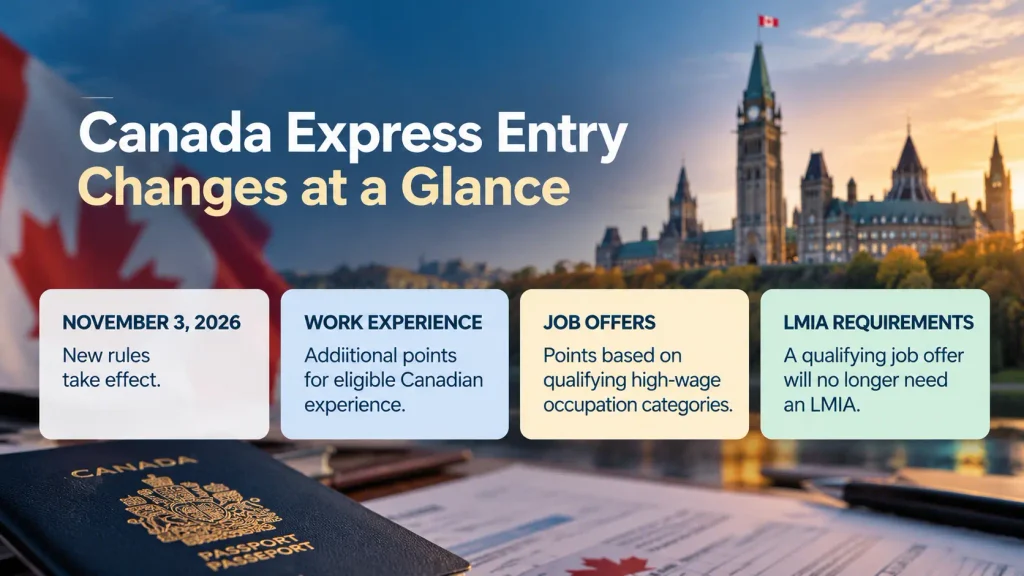
Canada’s Express Entry system is set for a major change on November 3, 2026. The new rules will change how candidates receive Comprehensive Ranking System (CRS) points for qualifying Canadian work experience and job offers.
For some applicants, the changes could provide a welcome boost to their CRS scores. Others may see little difference, depending on their occupation, work history and eligibility.
One of the biggest changes is the introduction of a Labour Market Integration factor, which will recognize qualifying Canadian work experience and job offers in eligible high wage occupations. Qualifying job offers will also no longer need an LMIA to earn points under the revised rules.
If you are already in the Express Entry pool or planning to apply for Canadian permanent residence, here is what you need to know before the changes take effect.
1. A New Labour Market Integration Factor
The revised CRS will introduce a Labour Market Integration factor to recognise candidates with qualifying Canadian work experience or a qualifying job offer in an eligible high wage occupation.
Candidates will be assessed under either route and receive the higher applicable score. They cannot claim points for both options under this factor.
The maximum available score is 150 points for candidates without an accompanying spouse or common law partner, and 140 points for candidates with an accompanying spouse or partner.
This could make a difference for people who have already established themselves in Canada’s labour market. However, the actual benefit will depend on their individual circumstances and whether they meet the eligibility requirements.
2. Canadian Work Experience Could Earn You More CRS Points
Canadian work experience remains an important part of Express Entry. Under the revised rules, candidates with at least 12 months of qualifying Canadian work experience in an eligible high wage occupation may receive additional points based on the occupation’s wage category.
The additional points are as follows:
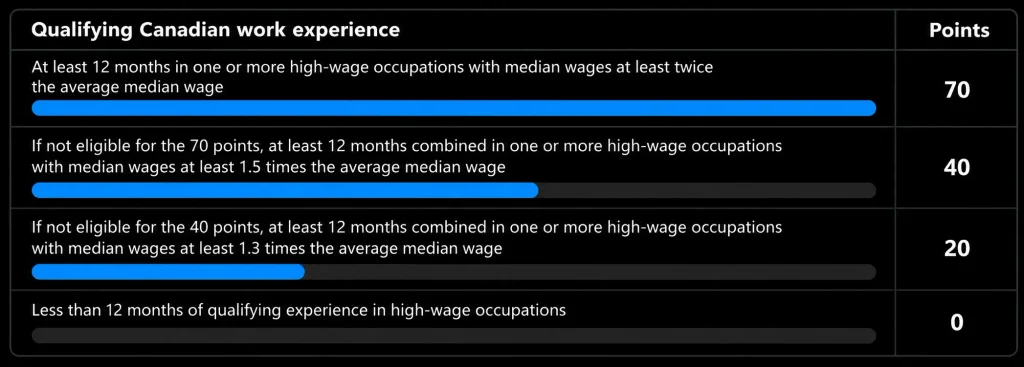
These are additional points on top of the regular CRS points for qualifying Canadian work experience, subject to the applicable maximum.
Your personal salary alone does not determine whether you qualify. Your occupation’s National Occupational Classification (NOC) code and its designated wage category are important. A high salary does not automatically make an occupation eligible.
Applicants should also remember that work experience gained outside Canada will not meet the Canadian work experience requirement for this particular benefit.
3. Job Offers Could Earn Up to 100 CRS Points
Another major change is the return of CRS points for qualifying job offers.
Under the new system, eligible candidates may receive points based on the wage category of the occupation associated with their job offer.
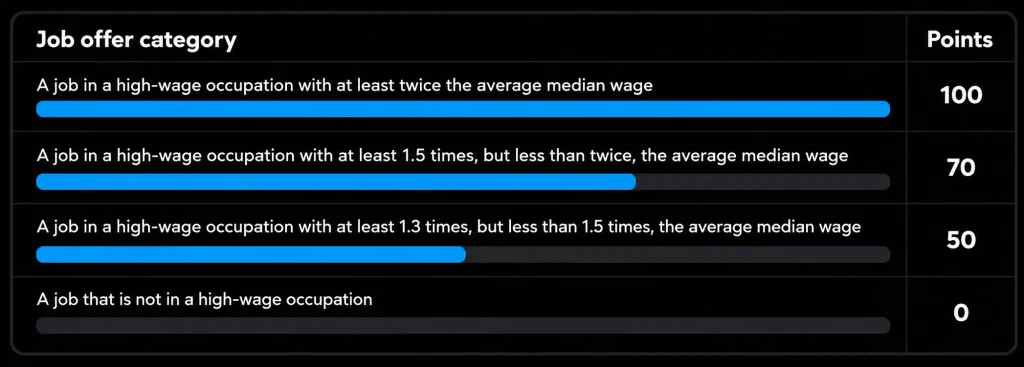
The thresholds refer to the designated wage category for the occupation, not simply the salary an employer offers an individual candidate. Applicants should check the applicable NOC classification and official wage criteria before assuming that a position qualifies.
A job offer alone does not guarantee extra CRS points. The offer must be genuine and meet the relevant requirements.
For candidates who already have a Canadian job offer, reviewing its eligibility before November 3 could be worthwhile.
4. An LMIA Will No Longer Be Required for Qualifying Job Offers
The Labour Market Impact Assessment, commonly known as an LMIA, is another area where the rules are changing.
From November 3, 2026, qualifying job offers will no longer need an LMIA to receive CRS points under the revised system, provided the other requirements are met.
An LMIA will not provide additional CRS points or give a candidate priority in the Express Entry pool.
Job offers may relate to new or existing positions and may come from new or existing employers. However, immigration officers will continue to assess whether an offer is genuine and whether the employer and candidate satisfy the applicable requirements.
This could simplify the process for some applicants and employers. It does not mean that every Canadian job offer will qualify for points.
What if your job offer does not have an LMIA?
IRCC has published temporary instructions for candidates entering qualifying job offers without an LMIA because the online profile system may not immediately reflect the revised requirements.
Candidates should follow the latest official instructions carefully rather than guessing which information to enter.
Read the official IRCC instructions on Express Entry changes before updating your profile.
5. Existing Express Entry Profiles Will Be Recalculated
Already in the Express Entry pool? You may not need to create a new profile simply because the rules are changing.
IRCC has indicated that existing profiles will be recalculated when the new rules take effect. The process could take up to two weeks, during which invitation rounds will be paused.
If you have a qualifying Canadian job offer, make sure your profile contains accurate and complete information before the changes take effect.
Keep in mind that a revised CRS score does not guarantee an Invitation to Apply (ITA). Invitations will continue to depend on the applicable selection criteria and the results of individual invitation rounds.
6. A Job Offer Can Still Help Even If It Earns No CRS Points
This is an important distinction that applicants should not overlook.
A job offer that does not qualify for the new high wage CRS points may still help someone meet the eligibility requirements of the Federal Skilled Worker Program or Federal Skilled Trades Program.
The rules for qualifying for an immigration program are different from the rules for receiving additional CRS points. A job offer may therefore have immigration value even if it earns zero points under the new Labour Market Integration factor.
The offer must still satisfy the requirements of the relevant program.
Before dismissing a job offer, assess both your program eligibility and your CRS score. They are two separate questions.
What Should Express Entry Candidates Do Before November 3?
With the changes approaching, this is a good time to review your profile and make sure your information is accurate.
Check your Canadian work experience. Confirm that your experience meets the applicable requirements and that you have correctly recorded its duration.
Verify your NOC code. Your occupation should match your actual job duties, not just the title on your employment contract.
Check the eligible wage category. Do not assume that a high personal salary automatically qualifies your occupation for additional points.
Review your job offer. If you have a Canadian employer, check whether the position meets the revised requirements and whether it could earn CRS points.
Reassess your CRS score. Understand how the changes could affect your ranking, but do not assume that additional points guarantee an invitation.
Follow IRCC’s latest instructions. If you are already in the pool, check whether any profile information needs to be updated and follow the official guidance for job offers without an LMIA.
Final Thoughts
Canada’s upcoming Express Entry changes could create new opportunities for candidates with qualifying Canadian work experience or job offers in eligible high wage occupations.
For some, the revised scoring system could improve their position in the pool. For others, the effect may be limited. The outcome will depend on their occupation, work history, job offer and individual eligibility.
The best approach is to review your profile before November 3, understand which rules apply to your circumstances and use IRCC’s official guidance when making changes.
Official source: IRCC: Express Entry changes to points for Canadian work experience and job offers.