


Canada’s immigration landscape is entering a new phase. After several years of tighter admission targets and efforts to manage temporary resident numbers, the federal government is preparing its next Immigration Levels Plan, covering the period from 2027 to 2029.
For people planning to immigrate to Canada, this announcement could provide important clues about which immigration pathways will receive greater attention, how permanent residence admissions may evolve, and what role international students and foreign workers will play in the country’s immigration strategy.
The existing immigration plan sets a target of 380,000 permanent resident admissions annually for 2026, 2027 and 2028. However, the figures for 2027 and 2028 are provisional planning targets that may be revised in the next announcement.
The upcoming plan is also expected to introduce official targets for 2029, extending the government’s immigration planning horizon.
Does this mean Canada will make immigration easier in 2027? Not necessarily. Even if the overall number of permanent resident admissions increases, the effect on individual applicants will depend on program allocations, eligibility criteria, provincial priorities and selection policies.
For prospective immigrants, understanding these differences is essential when deciding which pathway to pursue.
In this guide, we examine Canada’s current immigration targets, the possible direction of future policy, the programs worth monitoring and the practical steps applicants can take while waiting for the next announcement.
Canada’s Immigration Targets: Where Things Stand
The existing 2026 – 2028 Immigration Levels Plan provides the starting point for understanding what could happen next.
The following figures are the established planning targets in the existing plan, rather than predictions about what the government will announce for 2027 – 2029.
Current Permanent Residence Targets
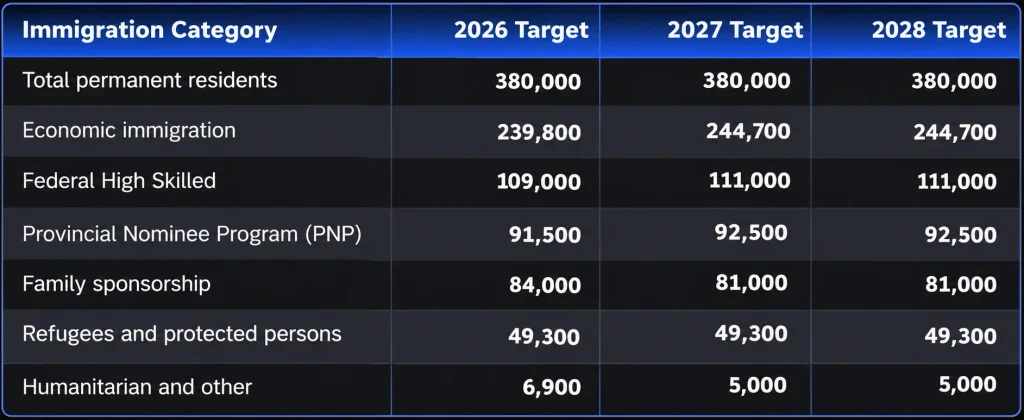
Source: IRCC’s Supplementary Information for the 2026–2028 Immigration Levels Plan.
These numbers show that economic immigration is a major component of Canada’s permanent residence strategy. Federal economic programs and provincial nomination pathways therefore remain important categories to watch when the next plan is released.
The table also illustrates why applicants should look beyond the overall permanent residence target. A change in the number of spaces assigned to a particular category could affect its opportunities even if the total number of admissions remains unchanged.
What About Temporary Residents?
Canada’s existing plan also sets targets for new temporary resident arrivals.
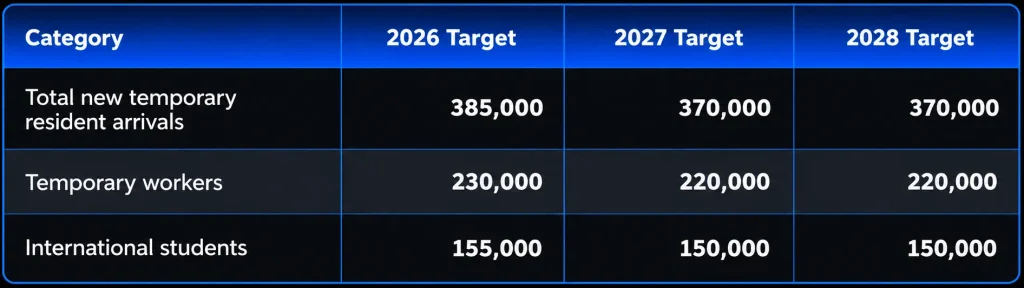
These figures reflect the government’s effort to manage the number of people entering Canada temporarily while maintaining immigration pathways that support economic and social needs.
The next plan will help clarify whether this approach continues unchanged or whether the government makes adjustments to particular categories.
Could Canada Increase Permanent Residence Admissions in 2027?
One of the biggest questions surrounding the next announcement is whether Canada will maintain its existing permanent residence target or begin increasing admissions again.
A target of 380,000 remains the established planning figure for 2027. A higher figure is a possibility, but it should not be treated as a confirmed outcome.
Prime Minister Mark Carney’s reported comments in September 2026 about the possibility of returning to controlled population growth have added to the discussion about Canada’s longer-term immigration direction.
At the same time, the government continues to face competing considerations, including housing availability, infrastructure capacity, labour-market demand and the management of temporary residents.
These factors leave room for several possible policy directions.
Scenario 1: Permanent Residence Targets Remain Stable
The government could retain the current target while adjusting how admissions are distributed among economic immigration, family sponsorship and other categories.
Under this scenario, applicants might see changes in individual programs without a major increase in total admissions.
Scenario 2: A Gradual Increase in Admissions
The government could introduce a moderate increase if it determines that demographic and economic conditions support additional immigration.
Immigration News Canada’s published assessment has identified a possible 2027 target of 390,000 – 400,000 as one scenario to watch. This is an estimate, not an official government commitment.
Scenario 3: A Longer-Term Adjustment Rather Than an Immediate Increase
Another possibility is that the government maintains restraint in the near term while setting out a different trajectory for 2028 and 2029.
The new three-year plan will be important because it can reveal whether Ottawa intends to maintain its current approach or gradually change the balance between population growth and immigration controls.
For applicants, the practical lesson is simple: avoid making major financial or career decisions based on an unconfirmed target. Wait for the official plan and examine the allocations relevant to your circumstances.
Express Entry: Why Program Allocations Matter
Express Entry is one of the most closely watched systems for skilled workers seeking Canadian permanent residence.
The Federal High Skilled category has an existing target of 111,000 admissions in both 2027 and 2028. Whether this allocation changes in the next plan could be an important development for candidates considering an Express Entry pathway.
However, the number of admissions allocated to a category does not directly determine an individual candidate’s chances of receiving an invitation.
Candidates should also consider:
- Their Comprehensive Ranking System (CRS) score.
- Their eligibility for the relevant immigration program.
- The types of Express Entry draws conducted by IRCC.
- Whether their occupation or other qualifications fit a category-based selection round.
- Their language test results, education and work experience.
A higher allocation could create additional capacity, but its effect would depend on how IRCC conducts selection rounds and distributes invitations.
What Should Express Entry Candidates Do Now?
Rather than waiting passively for the new plan, candidates can use this period to strengthen their profiles.
Review your language test results, check that your educational credentials are properly assessed where required, update your work experience and identify any legitimate opportunities to improve your CRS score.
Candidates should also keep their profiles accurate and monitor official IRCC announcements for changes to selection categories or program requirements.
Provincial Nominee Programs Could Remain Important
The Provincial Nominee Program (PNP) is another area worth watching in the upcoming immigration announcement.
The existing plan sets the PNP target at 92,500 admissions for both 2027 and 2028. That is considerably higher than the 55,000 target for 2026 under the previous 2025–2027 plan.
This allocation highlights the importance of provincial nomination within Canada’s economic immigration strategy.
Provinces and territories have different labour-market requirements, population needs and nomination priorities. As a result, the most suitable provincial pathway can vary considerably from one applicant to another.
A change in the overall PNP allocation could affect provincial planning, but it would not automatically mean that every province will receive more nomination spaces.
How Applicants Can Prepare for Provincial Immigration
Prospective applicants should research provincial programs based on their actual qualifications rather than selecting a province solely because they expect it to offer more places.
Consider the following factors:
- Occupation: Does your work experience match the province’s labour-market priorities?
- Employment: Does the pathway require a job offer or employment with a qualifying employer?
- Education: Are there relevant provincial pathways for graduates of eligible institutions?
- Language proficiency: Do you meet the applicable language requirements?
- Connection to the province: Does your education, employment or other experience support eligibility under the relevant stream?
Provincial nomination requirements can change independently of the federal immigration levels plan. Applicants should therefore verify the current criteria directly with the relevant provincial or territorial government.
International Students: What Could the Next Plan Mean?
International students remain an important part of Canada’s temporary immigration system, but the government has been working to reduce the number of temporary residents.
Under the existing plan, the target for new international student arrivals is 150,000 in both 2027 and 2028.
A future adjustment is possible, but applicants should not assume that Canada will return to the higher student intake levels seen in previous years.
The government’s stated objective of bringing temporary residents below 5% of the population by the end of 2027 remains an important consideration.
For students planning to study in Canada, the immigration levels announcement is only one part of the decision.
Important Considerations Before Applying
1. Choose a program that fits your career goals. Consider the quality and relevance of the education, total costs and employment prospects after graduation.
2. Understand study permit requirements. Admission to an educational institution does not, by itself, guarantee approval of a study permit.
3. Check post-graduation work permit eligibility. Eligibility depends on the applicable rules and the institution and program involved.
4. Do not assume that studying in Canada guarantees permanent residence. Permanent residence is a separate process with its own eligibility criteria and selection requirements.
5. Plan financially. Tuition, accommodation, living expenses and other costs should be assessed carefully before making a commitment.
Even if student targets change in 2027, the rules governing study permits and post-graduation work permits may have their own eligibility conditions and policy timelines.
Temporary Foreign Workers: Will Opportunities Change?
Canada’s temporary worker targets may also be reviewed as part of the next Immigration Levels Plan.
The existing target for new temporary worker arrivals is 220,000 in both 2027 and 2028, including workers under the International Mobility Program and the Temporary Foreign Worker Program.
The overall figure does not tell the whole story. These programs operate under different rules, and the distribution of workers can change according to government policy and labour-market requirements.
Employers, for example, may face different requirements depending on the program, occupation and circumstances of employment.
For foreign workers, the next announcement could provide useful context, but it will not necessarily determine whether a particular employer can hire them or whether they qualify for a work permit.
Workers considering Canada should focus on identifying a legitimate employment opportunity, checking the applicable work permit requirements and understanding any restrictions attached to their authorization.
Those hoping to transition from temporary status to permanent residence should also evaluate the available pathways separately instead of assuming that Canadian work experience automatically leads to permanent residence.
Francophone Immigration: An Area to Watch
French-language immigration outside Quebec is another important part of Canada’s broader immigration strategy.
The existing plan sets the Francophone permanent residence target outside Quebec at 9.5% for 2027 and 10.5% for 2028.
The figures indicate an established policy direction toward increasing French-speaking immigration outside Quebec.
Immigration News Canada’s assessment has identified a possible trajectory toward 12% by 2029, although that figure remains a projection until the government announces an official target.
For eligible French-speaking candidates, this area deserves attention when reviewing potential immigration pathways.
Depending on their circumstances, candidates may wish to investigate Express Entry selection for French-language proficiency, relevant provincial nomination streams and other eligible Francophone immigration initiatives.
French-language ability alone does not guarantee an invitation or permanent residence. Applicants must still meet the relevant program criteria and any applicable selection requirements.
Nevertheless, candidates with strong French-language skills may benefit from examining how those skills fit into Canada’s current and future immigration priorities.
When Is Canada Expected to Announce Its Next Immigration Plan?
The 2027–2029 Immigration Levels Plan is expected around early November 2026.
Section 94(1) of the Immigration and Refugee Protection Act establishes the annual reporting requirement. If the relevant House of Parliament is not sitting on November 1, the report must be tabled within the next 30 days on which that House is sitting.
Because November 1, 2026, falls on a Sunday, the precise release date remains uncertain. Canada’s previous plan was released on November 5, 2025, making the first week of November a reasonable point to watch.
The official announcement should provide a clearer picture of the government’s permanent residence and temporary resident targets for the coming years.
Applicants should rely on the published plan and subsequent IRCC program announcements rather than unofficial forecasts.
How Prospective Immigrants Can Prepare Before the Announcement
The period before a new immigration plan is released can be useful for reviewing your options and identifying areas that need attention.
You do not need to wait for the government to announce new targets before preparing your application strategy.
A Practical Preparation Checklist
- Review your eligibility for Express Entry and other relevant economic immigration programs.
- Check the validity of your language test results.
- Arrange an educational credential assessment if your chosen pathway requires one.
- Calculate your CRS score, where applicable, and identify realistic ways to improve it.
- Research provincial nomination streams that align with your occupation and experience.
- Verify the current requirements for study permits or work permits if you are considering temporary residence.
- Prepare essential documents and keep your personal information up to date.
- Follow official IRCC and provincial government announcements for confirmed policy changes.
Your best pathway will depend on your individual profile, not just the total number of immigrants Canada plans to admit.
A candidate with strong language results and relevant work experience may have different options from an international student, a foreign worker or someone applying through family sponsorship.
Taking time to compare eligible pathways can help you make more informed decisions when the new targets become available.
Conclusion: Plan Around Your Eligibility, Not Just the Headlines
Canada’s upcoming 2027–2029 Immigration Levels Plan will be an important development for skilled workers, provincial nominee candidates, international students, temporary foreign workers and families considering permanent residence.
The announcement will clarify whether Canada intends to maintain its existing admission targets or adjust its approach in response to economic, demographic and political considerations.
However, the headline permanent residence figure will be only one part of the picture. Program allocations, provincial priorities, selection criteria and temporary resident policies will also influence the options available to prospective applicants.
For now, the most sensible approach is to prepare using the rules currently in force, monitor official announcements and assess immigration pathways according to your own qualifications and circumstances.
An informed immigration strategy starts with understanding your eligibility and the available pathways, not relying on predictions about future targets.
Sources and Editorial Disclaimer
This article is based on the immigration targets, demographic figures and policy developments described in the reference material, including IRCC’s 2026–2028 Immigration Levels Plan, Statistics Canada’s population estimates released in September 2026, and the applicable legislative reporting requirements.
Projected future targets are identified as estimates rather than confirmed government policy. Figures and program rules should be checked against the latest official publications before this article is published.
This article is intended for general informational purposes only and does not constitute legal or immigration advice. Immigration policies, program requirements and admission targets may change. Readers should consult official government sources or a qualified Canadian immigration professional for advice specific to their circumstances.