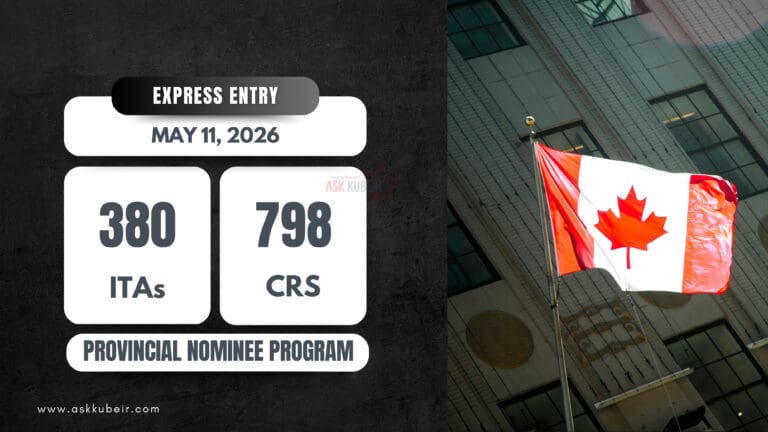


Canada has again invited Provincial Nominees through the Express Entry system. This is the second Provincial Nominee Program (PNP) draw of May 2026. The latest round highlights Immigration, Refugees and Citizenship Canada’s ongoing preference for candidates who already have a provincial nomination and can assist in meeting regional labour market needs.
This was the twenty-eighth Express Entry draw of 2026 and it adds to a growing trend of targeted invitations rather than broad all-program selections.
What was the outcome of the latest Express Entry draw?
Canada issued 334 Invitations to Apply (ITAs) for permanent residence via the Express Entry linked Provincial Nominee Program stream on May 25, 2026. Invited candidates needed a minimum Comprehensive Ranking System (CRS) score of 805.
The tie-breaking rule for this drawing was October 16, 2025 at 18:16:33 UTC. This means that candidates with the same CRS score were ranked by the date and time of their Express Entry profile submission.
Why is the CRS score so high?
PNP-specific Express Entry draws tend to have much higher CRS cut-offs, as candidates receive an additional 600 points after provincial nomination. Even those with a moderate base score can reach into the 800s with a nomination from a province or territory.
This is why the most recent draw had a CRS requirement of 805 despite the fact that it attracted a relatively small pool of candidates.
How many PNP invitations Canada issued in May 2026?
Provincial Nominee Program Draw May 2026 These rounds resulted in 714 Invitations to Apply, reaffirming IRCC’s ongoing focus on provincially-selected skilled workers.
| Draw Date | Type of Draw | Number of ITAs | Minimum CRS Score |
|---|---|---|---|
| May 25, 2026 | Provincial Nominee Program | 334 | 805 |
| May 11, 2026 | Provincial Nominee Program | 380 | 798 |
How Active Has Express Entry Been in 2026?
Canada has held 28 Express Entry draws so far in 2026, issuing 72,341 Invitations to Apply across multiple categories. The most invitations have gone to candidates in the Canadian Experience Class and French-language proficiency categories.
The current selection approach reflects that Canada is increasingly targeting applicants that meet specific labour shortages or economic priorities.
| Types of Draw | Number ITAs | Number of Draw |
|---|---|---|
| Provincial Nominee Program | 4,450 | 11 |
| Canadian Experience Class | 34,250 | 8 |
| French-Language proficiency | 26,000 | 5 |
| Physicians with Canadian work experience | 391 | 1 |
| Healthcare and social services | 4,000 | 1 |
| Senior Managers with Canadian Work Experience | 250 | 1 |
| Trades Occupations | 3,000 | 1 |
| Total | 72,341 | 28 |
What Are The Express Entry Categories To Watch In 2026?
The 2026 immigration system in Canada is still mostly based on category-based selection. IRCC is not conducting regular general draws but is instead prioritizing applicants with skills or experience that are deemed to be useful to the Canadian economy.
Invitations are currently being targeted to French-speaking candidates, healthcare and social services professionals, STEM workers, trade occupations, education professionals, transport workers, physicians with Canadian experience, senior managers, researchers and skilled military recruits.
This strategy gives Canada a more direct way to tackle workforce shortages and improves the odds for eligible candidates in priority sectors to get invitations for permanent residency.
What Does This Mean For Prospective Students?
The latest draw once again proves that provincial nominations are amongst the best ways to become a Canadian permanent resident through Express Entry. Candidates who get nominated by a province continue to enjoy a major CRS boost, often putting them well above invitation cut-offs.
At the same time, category-based selection is altering the immigration landscape. If you have experience in a priority occupation or strong French-language ability, you may still find better opportunities through 2026 without very high CRS scores.